Today, we’ll look at a few choking & strangulation techniques in the category of “originally from Judo” but now used – if not even sometimes “claimed as their own” by other martial arts – particularly BJJ (the “melting pot” of the grappling world). The term choke and strangulation are sometimes used inter-changably, but they are very different concepts and a proper understanding is essential before moving forward. There’s a reason that no one under orange belt is allowed to perform chokes or strangulations in Judo training or competition! Focus on the lower risk techniques first, then as you progress and expand your knowledge you can start to explore the rest the martial art has to offer.
It would be useful to clarify that a choke involves compression or other restriction of the throat, larynx, adam’s apple and/or “wind pipe” (trachea) to restrict oxygen intake and swallowing functions. Without oxygen, after anywhere from 20 to 120 seconds (sometimes a bit more in the extremely fit), depending on the persons involved, fainting and a risk of death by suffocation occurs. There is a higher likelihood of damage from these techniques as there is more time to struggle while force is resisted and applied.
Strangulation is the compression or other restriction of arteries (such as the carotid and/or vertebral) which restricts blood flow to the brain and/or spinal cord or other extremities. Without blood flow to the brain especially, a person risks unconsciousness within 4 to 20 seconds, and brain death or bodily death as it goes beyond that – especially approaching the minute mark or more – but often a fair bit less can also pose risks. Although less of a struggle ensues, due to proximity to all the same body parts there is still a possibility of all the same injuries in these techniques as well. A proper strangle greatly reduces the choking action, but there is likely still some, but this is the goal in most techniques referred to as a “choke”, to actually perform a more efficient and potentially less damaging “strangle” instead.
Some practitioners can simply hold their breath, go without a fresh supply of oxygen intake, or handle reduced/blocked blood flow far longer or shorter than others. So “sensible resistance .vs. force application levels” is not an exact science, which is why referees, instructors & practitioners all need to be trained for quick reactions and alertness when it comes to chokes and strangles. It does not always have to do with overall fitness levels as large muscles require more oxygen to feed the blood that pumps to them and more rapid blood circulation under duress, so its important to realize muscular folks sometimes can go a shorter duration without oxygen or full blood flow; however as expected the obese or unfit generally speaking do have a higher risk-level than active or athletic body types to such exposures.
Underlying health issues can further exacerbate an individual’s tolerances in either situation, so where sensible, these should be discussed with your instructor and/or training partners where this makes sense. Furthermore, it is generally considered higher risk for those over the age of 45 to face either situation (choking or particularly strangulation due to natural nearly unavoidable plaque & arterial buildup as we age) for any extended period of time or too frequently, so take this into account when training with older partners. Younger partners under the age of 18 whose central nervous system and heart haven’t completely developed yet are also susceptible to different kinds of injuries; particularly arterial dissection, trachial & laryngal fractures, fissures or tears, and spinal/neck injuries (although any of these and similar injuries could happen to anyone when techniques aren’t done or overseen properly).
Generally, if BJJ advises practitioners to go slowly and gradually increase pressure on a joint lock or choke in order to “give their opponent plenty of time to tap out” so we can continue to practice and learn together, then Judo airs even further on the side of caution and emphasizes that we should only apply such techniques “as briefly as possible for the teaching/learning and skill development goal to be realized“. At Judo class, its always better to proactively release an opponent than to “hold on a bit longer while they struggle to escape and decide if they want to tap”.
IMPORTANT: Neither choking nor strangulation should ever be performed or received in a careless manner and MUST in all cases be practiced with the supervision & oversight of a properly trained instructor, ideally with the appropriate first aid and/or medical first-responder certifications themselves, or with such services readily available nearby wherever such practice occurs. Requisite disclaimer done, don’t be stupid… “don’t try this at home”… and GET PROPER TRAINING!
Koshi Jime (aka. “clock choke”)
Probably the first Judo choke I was ever introduced to, this was always one of the strongest and most-used ground techniques in sport Judo in the 1980s into the 1990s. This is due to its usefulness attacking an uke who is sprawling to counter a takedown, turtling on hands & knees, or possibly even laying out flat/prone to try to stall for a restart rather than engaging on the ground.
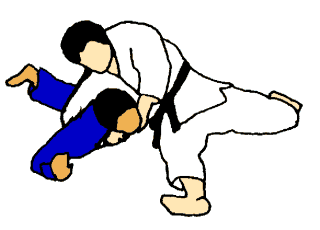
One of the most famous incidents of its usage in high-level competition was when Wallid Ismail, who himself was a Carlson Gracie black belt that also trained extensively in Judo, finished Royce Gracie with it in a BJJ tournament. This is believed to be Royce’s first ever loss as he had been undefeated in his weight class for a number of years beforehand, and one of his few uncontested losses by submission (TKO due to unconsciousness) rather than a loss on points, in any pure grappling match.
Jigoku Jime (crucifix choke)
Jigoku Jime (lit. translation “hell choke” but commonly known as a “crucifix choke”) is most commonly done from the Ura Osae or Yoko Jigoku Gatame positions but could also be done from Gyaku Ura Osae, Tate Ura Osae, Jigoku Gatame or even Ude Hishigi Ashi Gatame and similar variations where both of uke‘s arms are pinned.
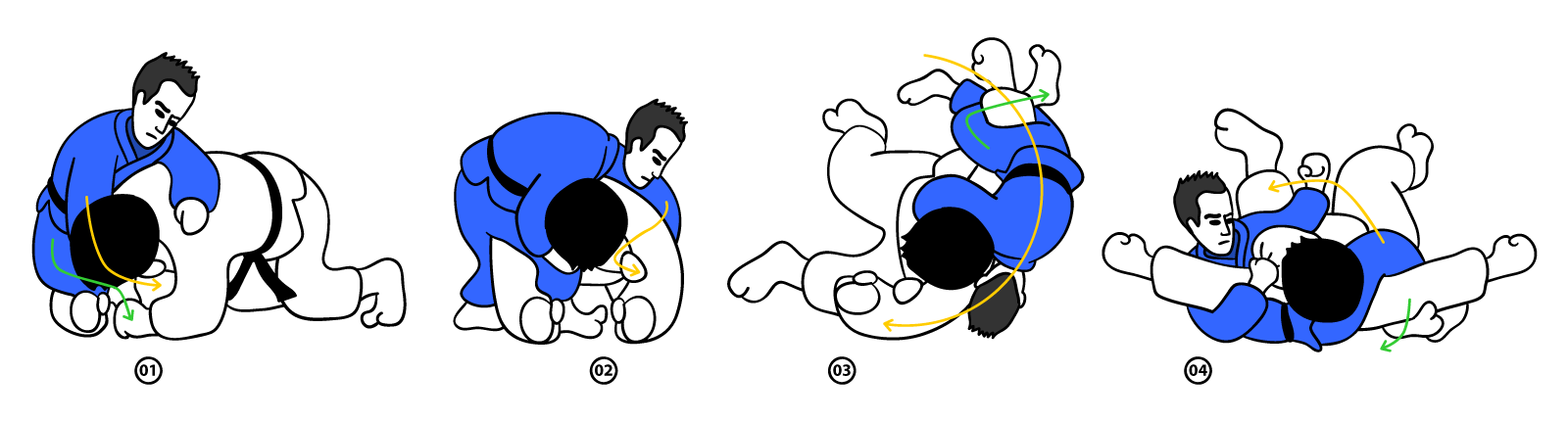
To avoid getting “ippon” called against you due to being on the bottom, tori would be better off applying this while on their side rather than directly underneath uke on their back (although for self-defense or other competitive purposes that under-bottom position is likely a more common way to end up in the prerequisite pin).
Finishing from any variation of this position can be a little tricky, so you have to be sure to get the hand gripping positions on the gi as precise as possible, so as little strength as possible is needed to finish. Apply very slowly in training as most competitors in both the Judo and BJJ communities are likely fairly unfamiliar with this position, so might not know to tap verbally or with their legs/hands instead of whole arm movements (since their arms themselves should be trapped when it is performed correctly). In fact, some BJJ black belts mistake it as a “neck crank” position, which it could become if done poorly, and many incorrectly think it is banned under IBJJF or IJF rules:
It may not look perfectly clean in competition, but its definitely possible to catch folks off guard with it, particularly as a transition from a failed Koshi Jime, our first technique we looked at, as you can see here:
Morote Jime (aka. “baseball bat choke”)
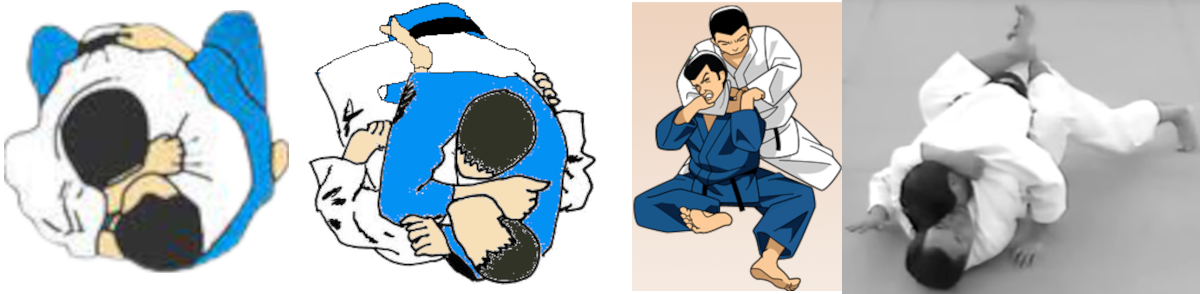
Morote Jime (lit. translation “both-handed choke”, or in the BJJ community known as a “baseball bat choke” as the forearm resembles a baseball bat across the throat and the hands are lined up in a position similar to gripping a baseball bat upright with both hands to swing at a pitch).
Most commonly performed from the top-mount or side-mount position, it can also be performed from north-south top, or north-south bottom from one’s back or even completed standing.
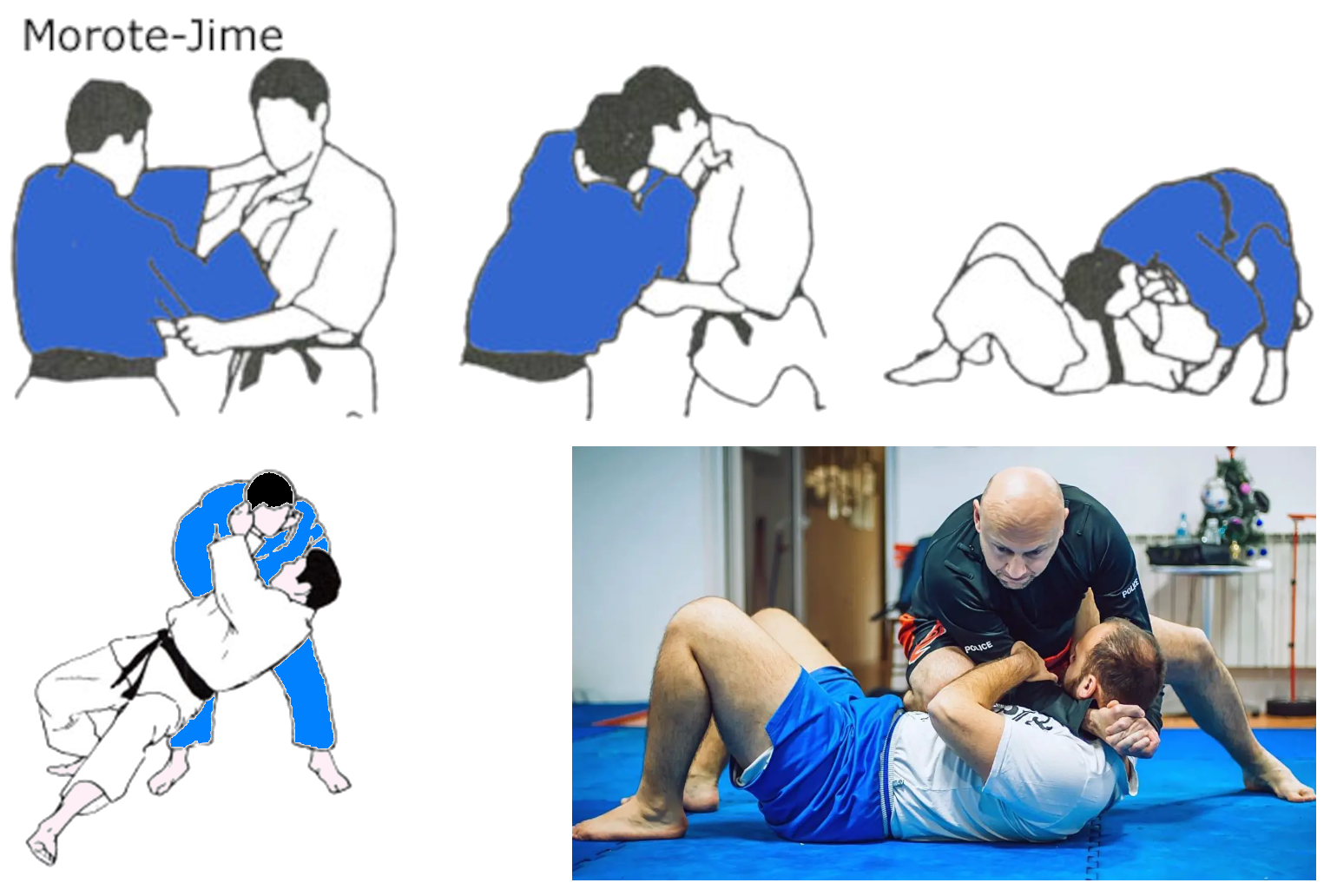
On the bottom left is a variation that’d be called “Yoko Morote Jime“, where you intentionally allow the opponent to pass to the side of the choke.
Magid Hage became fairly infamous for pulling off “Yoko Morote Jime” and other variations of this choke many times (particularly from underneath a larger opponent, catching them by surprise) in BJJ competitions at the elite level:
In other seminars he has admitted to cross-training in Judo with this same friend to help him get the 2 points from takedowns & throws in his BJJ competitions.
Sode Guruma Jime (aka. “Ezekiel choke”)
Sode Guruma Jime (or “sleeve encircling strangle”) became nicknamed the “Ezekiel choke” in BJJ circles due to its frequent use by Ezequiel Paraguassú, a Judoka from Brazil who also competed occasionally in BJJ and submission grappling tournaments or special cross-over matches. He finished some bigger, tougher, stronger competitors and so like most techniques outside the core BJJ curriculum (americana, kimura, etc) it was adopted under his name, although he never claimed to have invented it, as it clearly predates him perhaps by centuries.
Not to pick on Royce who was a pioneer in the sport of MMA and had many great accomplishments in BJJ as well, but the martial arts community had somewhat of a fascination with the Gracies and how to beat them after their infamous “open challenge” of the late 1980s into the 1990s and 2000s for anyone to come challenge them in their rule set, any day.
Hidehiko Yoshida .vs. Royce Gracie at PRIDE Shockwave 2002 was probably the most famous if not most controversial application of the Sode Guruma Jime technique in a modern elite grappling match.
Many in the Judo world familiar with the technique believe Royce was either falling out of consciousness, or, very close and the the fight was stopped properly at the last responsible and safe moment. Meanwhile, many in the BJJ world contended that this is not a very threatening technique and he was merely relaxing to gain his breath and conserve energy to get ready to escape, or to lull his opponent into a false sense he was winning so he could explode out and surprise him. You can decide for yourself. The controversy would lead to a rematch in MMA this time, where Royce chose not to wear a gi and emphasized alot more striking than we had ever seen the Brazilian use in matches to that date.
Either way, one shouldn’t doubt the seriousness of the technique when done well as it cuts off blood flow to the brain just like any other more frequently seen BJJ submission such as Sankaku Jime (triangle), Hadaka Jime (rear naked choke), Kata Gatame Jime (head & arm), etc. Even when done poorly it is a dangerous choke to “just hang out” in, you should escape immediately if you can, or, tap if you can not, since the improper choke would be on the windpipe, throat and/or adam’s apple (for men) and could have damaging effects. In these situations in training, its probably best to tap and help whoever applied it understand the risks of using force when it is not applied in the proper position.
Hasami Jime (aka. “scissor choke”)
Really digging back into the old school with this one, Hasami Jime (known as the “scissor choke” by the few who are familiar with it) certainly isn’t taught in most BJJ curriculum.
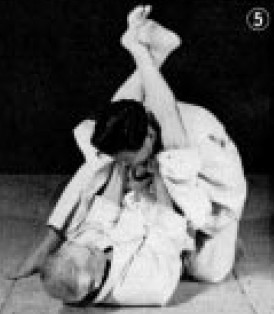
Like most of the techniques here, it can be performed from many different angles or positions, the key is trapping uke‘s head with your legs in a cross-entaglement, and in the traditional case controlling posture and/or adding a “Ryote Jime“-styled gi choke to the equation. For self-defense it doesn’t really matter how one achieves it (as this is more of a survival technique when done from the bottom), but for sport Judo it is essential that at least one of uke‘s arms is inside of tori‘s leg entanglement, it could potentially done with both arms inside but would require a size and/or grip & squeeze strength differential between competitors if done that way.
Catch Wrestling has a similar technique with no hands at all called the “head scissors”, this variation is completely illegal in Judo competition as it applies both legs directly on the head, neck or spine with no hands or arms in between. A variation seen in no-gi grappling competitions that would be legal has recently been innovated on top of this old traditional “get out of trouble quick” technique, known as “the teepee choke”. It is likely more popular than the traditional grips and application, as this variation can be performed without a gi or loose clothing on your opponent. This would be allowed in Judo so long as again at least one of their arms remains trapped inside thus both legs’ pressure aren’t being applied directly to the neck/spine (which would definitely make it illegal in Judo competitions).
References
- Shedding Light on Known Dangers from Chokes in Combat Sports: https://combatsportslaw.com/2019/06/19/shedding-light-on-known-dangers-from-chokes-in-combat-sports/
- The A-Z of Judo, by Syd Hoare (1993): https://www.goodreads.com/book/show/2914587-the-a-z-of-judo
- Ask A BJJ Black Belt – Are BJJ Chokes Dangerous?: https://tackettjiujitsu.com/are-bjj-chokes-dangerous/
- 7 Key Things To Know About Getting Choked Out In BJJ: https://bjj-world.com/getting-choked-out-in-bjj/
- How dangerous is it to choke someone unconscious or to be choked unconscious?: https://martialarts.stackexchange.com/questions/33/how-dangerous-is-it-to-choke-someone-unconscious-or-to-be-choked-unconscious
- Loss of Consciousness in Judo: Similarities and Differences Between Traumatic Brain Injury and Choking Techniques (Shime-Waza): https://www.researchgate.net/publication/371937092_Loss_of_Consciousness_in_Judo_Similarities_and_Differences_Between_Traumatic_Brain_Injury_and_Choking_Techniques_Shime-Waza
- High-rate settlement and unconsciousness with shime-waza in young Judo athletes from a video analytic study in Judo World Championships: https://www.sciencedirect.com/science/article/abs/pii/S1440244022002481
- Long-term effects of boxing and judo-choking techniques on brain function: https://pubmed.ncbi.nlm.nih.gov/10935832/

 Musa Betsu Kyu Judo club