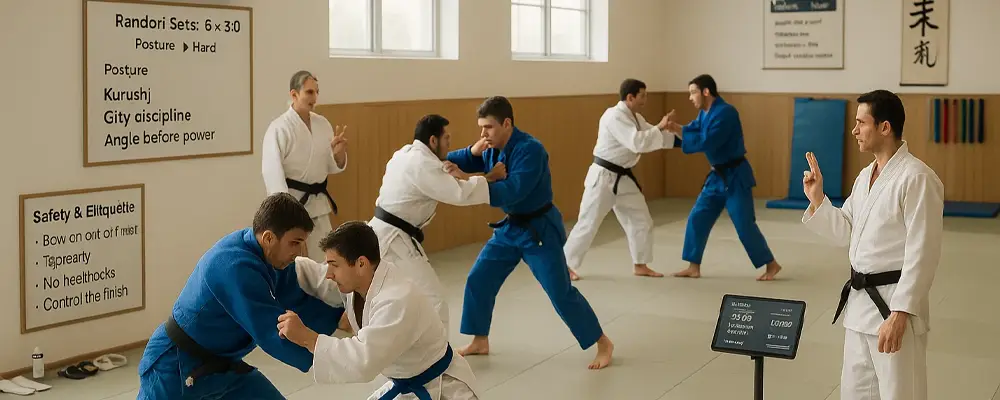
“Randori” (乱取り) literally translated as “free exercise” was conceived by Jigoro Kano for the Kodokan as a method of practicing hard while minimizing the risk of sustaining injuries. Kano defined the purpose of his randori method as “enticing interest in students through free-form technique application focused on safety, physical strength development and balance development”. To simplify the concept, it is basically sparring, where two competitors at a time are trying to implement legal Judo techniques with varying levels of resistance and exertion on either side, according to the rules of a regular competitive match. It is one of the most effective training mechanisms for preparing for each of the sport, martial art & self-defense sides of Judo.
There are many different ways to do randori though, and it should not always be two people going at one another fighting as hard as possible (in fact it should rarely be). Here are the top 25 most common, from lower to higher exertion & intensity levels:
Today, we’ll look at a few choking & strangulation techniques in the category of “originally from Judo” but now used – if not even sometimes “claimed as their own” by other martial arts – particularly BJJ (the “melting pot” of the grappling world). The term choke and strangulation are sometimes used inter-changably, but they are very different concepts and a proper understanding is essential before moving forward. There’s a reason that no one under orange belt is allowed to perform chokes or strangulations in Judo training or competition! Focus on the lower risk techniques first, then as you progress and expand your knowledge you can start to explore the rest the martial art has to offer.
It would be useful to clarify that a choke involves compression or other restriction of the throat, larynx, adam’s apple and/or “wind pipe” (trachea) to restrict oxygen intake and swallowing functions. Without oxygen, after anywhere from 20 to 120 seconds (sometimes a bit more in the extremely fit), depending on the persons involved, fainting and a risk of death by suffocation occurs. There is a higher likelihood of damage from these techniques as there is more time to struggle while force is resisted and applied.
Strangulation is the compression or other restriction of arteries (such as the carotid and/or vertebral) which restricts blood flow to the brain and/or spinal cord or other extremities. Without blood flow to the brain especially, a person risks unconsciousness within 4 to 20 seconds, and brain death or bodily death as it goes beyond that – especially approaching the minute mark or more – but often a fair bit less can also pose risks. Although less of a struggle ensues, due to proximity to all the same body parts there is still a possibility of all the same injuries in these techniques as well. A proper strangle greatly reduces the choking action, but there is likely still some, but this is the goal in most techniques referred to as a “choke”, to actually perform a more efficient and potentially less damaging “strangle” instead.
Some practitioners can simply hold their breath, go without a fresh supply of oxygen intake, or handle reduced/blocked blood flow far longer or shorter than others. So “sensible resistance .vs. force application levels” is not an exact science, which is why referees, instructors & practitioners all need to be trained for quick reactions and alertness when it comes to chokes and strangles. It does not always have to do with overall fitness levels as large muscles require more oxygen to feed the blood that pumps to them and more rapid blood circulation under duress, so its important to realize muscular folks sometimes can go a shorter duration without oxygen or full blood flow; however as expected the obese or unfit generally speaking do have a higher risk-level than active or athletic body types to such exposures.
Underlying health issues can further exacerbate an individual’s tolerances in either situation, so where sensible, these should be discussed with your instructor and/or training partners where this makes sense. Furthermore, it is generally considered higher risk for those over the age of 45 to face either situation (choking or particularly strangulation due to natural nearly unavoidable plaque & arterial buildup as we age) for any extended period of time or too frequently, so take this into account when training with older partners. Younger partners under the age of 18 whose central nervous system and heart haven’t completely developed yet are also susceptible to different kinds of injuries; particularly arterial dissection, trachial & laryngal fractures, fissures or tears, and spinal/neck injuries (although any of these and similar injuries could happen to anyone when techniques aren’t done or overseen properly).
Generally, if BJJ advises practitioners to go slowly and gradually increase pressure on a joint lock or choke in order to “give their opponent plenty of time to tap out” so we can continue to practice and learn together, then Judo airs even further on the side of caution and emphasizes that we should only apply such techniques “as briefly as possible for the teaching/learning and skill development goal to be realized“. At Judo class, its always better to proactively release an opponent than to “hold on a bit longer while they struggle to escape and decide if they want to tap”.
IMPORTANT: Neither choking nor strangulation should ever be performed or received in a careless manner and MUST in all cases be practiced with the supervision & oversight of a properly trained instructor, ideally with the appropriate first aid and/or medical first-responder certifications themselves, or with such services readily available nearby wherever such practice occurs.
Requisite disclaimer done, don’t be stupid… “don’t try this at home”… and GET PROPER TRAINING!
This post will summarize some of the better low-risk, high-reward throws that can be used in BJJ (gi) and similar grappling competitions.
The chosen “Top 15 successful throws for BJJ & grappling competitions” key criteria (similar to “the best throws for MMA” article so you’ll notice some overlap) are lower likelihood of getting your back taken (i.e. less focus on full-body turning throws), also in most grappling competitions except ADCC-style rules, big slams are probably not allowed, so they must be techniques that can be performed with a high degree of control. That also means you have a good chance to dictate where the match goes (do you go for a specific side-control, mount, north-south, scarfhold, etc).
This post is meant to clear up some confusion around gripping in Judo, and also to act as a reference for the grips most commonly seen in Judo. Let’s start with some other relevant terms that would be helpful to know:
Ai Yotsu – same grips used by both persons (traditional grip)
Eri – Collar (lapel) of gi
Gi – uniform typically with long-sleeves and sown lapels (collars)
Hansoku Make – disqualification from current match
Happo no Kuzushi – Unbalancing in 8 directions
Jigotai – defensive position
Kenka Yotsu – opposite grips used by each person, one right/one left
Kinshi Waza – techniques prohibited in athletic Judo competitions (typically based on IJF rules)
Kumi Kata – gripping strategy & fighting and/or hand-fighting
Hikite – pulling hand, usually the hand gripping a sleeve but could be gripping elsewhere
Shido – penalty in current match
Sode – sleeve of gi
Tachi Waza – standing technique
Tori – attacker, or, person performing a technique
Tsurite – lifting hand, usually the hand gripping a collar but could be gripping elsewhere
Uke – defender, or, opponent receiving a technique
Waki – arm pit region between arm/back/torso (underneath the shoulder joint)
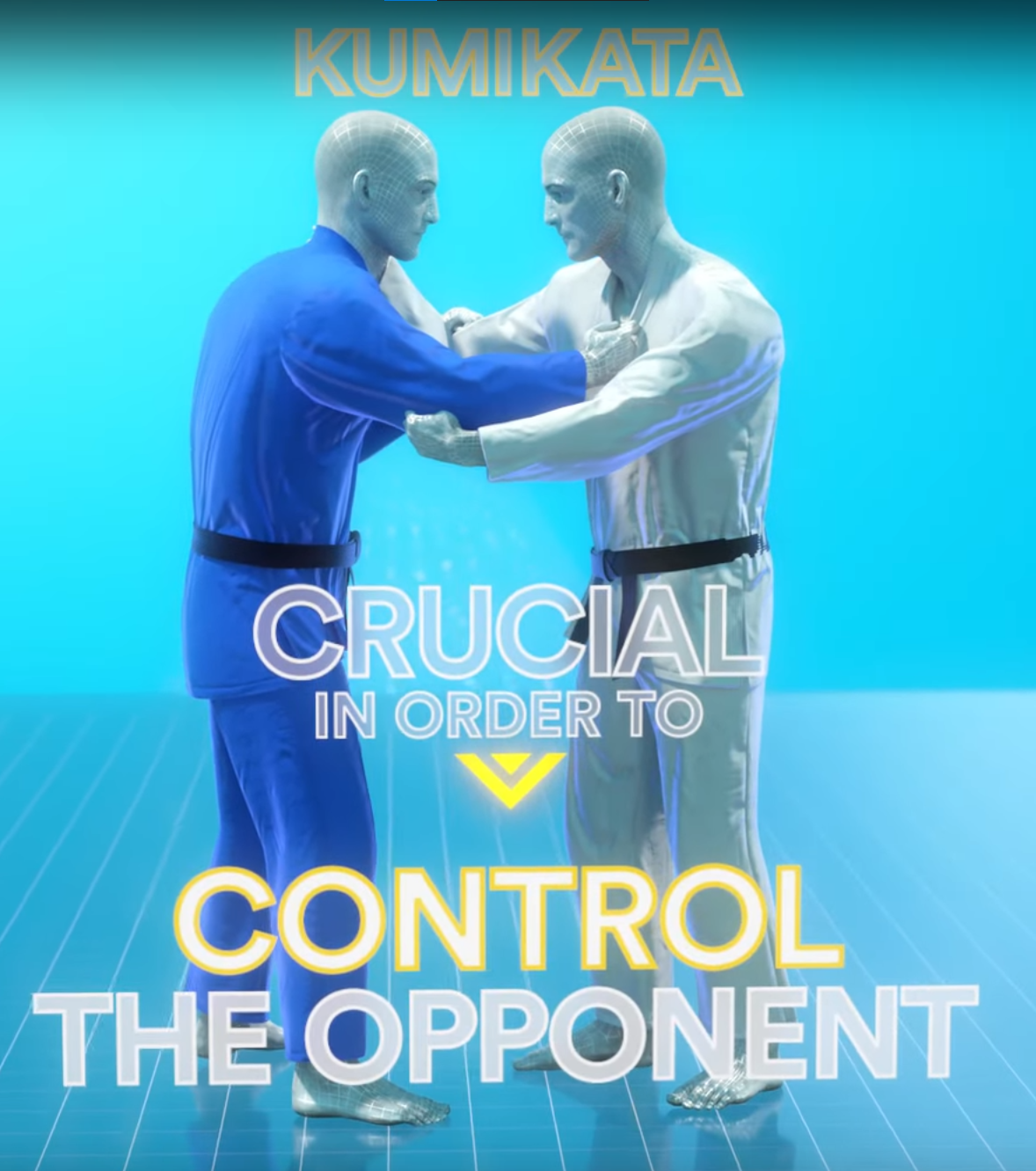
The importance of Kumi Kata (grip fighting) is often overlooked in Judo. It forms the basis of just about any attack. Not to mention, moving in aggressively without solid grips in place for control first should be considered reckless for the vast majority of Tachi Waza, and that itself can often even be penalized under failing to protect Uke. The following video does a great job at concisely summarizing Kumi Kata:
The remaining sections offer a description along with close-up photo example of all the main types of grips, grouped by “Standard” (traditional grips), “Modern” (accepted grips that require immediate throw attempts) or “Prohibited” (grips typically disallowed and/or frowned upon as unsportsmanlike in competition).
Standard Grips
Traditional grip (Ai Yotsu) – each have a high lead-hand lapel grip, and a mid-range rear-hand sleeve grip; note also the symmetric foot position (either left or right could be the lead, but the symmetry of the position is what makes it “Ai Yotsu“)
Traditional grip (Kenka Yotsu) – each have an opposite high lead-hand lapel grip, and opposite mid-range left-hand sleeve grip; note the asymmetric position of the feet (so per example below if the attacker has their left hand on top gripping the opponent’s lapel as lead Tsurite they also have their left leg forward, and right hand on their opponent’s sleeve as rear Hikite their right leg is back as supporting leg; or vice-versa)
The following is a list of the “Top 10 Judoka In MMA” using again like the previous post, no particular scientific formula, just going with general consensus. These are ranked not in order of their accomplishments but in the order in which they represent Judo exclusively, or made big shifts in consciousness towards awareness of Judo’s practical use in real fighting situations:
Ronda Rousey (Strikeforce / UFC)
Yoshihiro Akiyama (K1 / UFC)
Karo Parisyan (UFC / Bellator)
Hidehiko Yoshida (PRIDE / Sengoku)
Rick Hawn (Bellator)
Kazuhiro Nakamura (PRIDE / DREAM)
Hector Lombard (UFC)
Dong Hyun Kim (UFC)
Shinya Aoki (OneFC / RizinFF)
Fedor Emelianenko (PRIDE / Strikeforce / RizinFF)
WARNING: below there will be videos (non auto-playing) that depict scenes of violence that may be unsuitable for some audiences. These scenes are from legal, sanctioned, refereed combat sports events such as MMA, Judo, Combat Sambo, etc… and/or related supervised training activities.
A typical discussion on the topic of Kata in Judo might go something like this:
Sensei: "People today don't appreciate Kata"
Student#1: "What the heck is a Kata?"
Sensei: "A routine of techniques and movements practiced as a tool for learning"
Student#1: "Ohh, that stuff, like punching in the air and yelling ki-ai, well that's nice but Judo doesn't have Kata right?"
Student#2:(looks to Student#1 next to him)... "Pssst, I think it's a joke/test, he's trying to see if we confuse Judo with Karate or something?!"
Sensei:(slaps forehead)... "You both still have a lot to learn, now drop and give me 20 pushups."
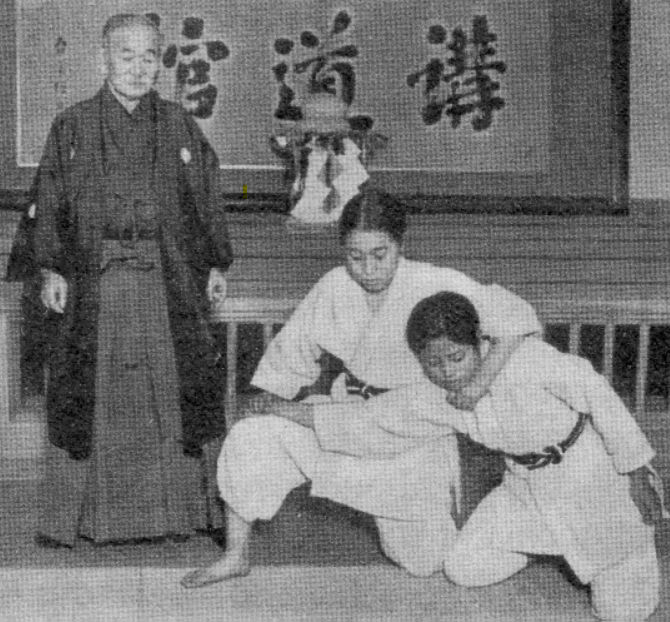
Jigoro Kano oversees students in performing Nage no Kata
The basic movements in a Kata can be used to assist in balance, strength & flexibility training in a manner relevant to most throwing techniques. Kata also assist in training spatial awareness, gripping, overall control, concentration, timing & that very important element of breathing.
Just ask some of the experts what the significance of Kata is:
“When properly performed, ju no kata gives a balanced exercise for the whole body. Constant use of this kata over an extended time period results in a harmoniously developed, flexible, and strong body, as well as giving the user the fundamental mechanics for sport and self defense Judo applications“
~ Donn F. Draeger (foremost western authority on Budo & translating martial arts texts/manuscripts)
“Kata is possibly the most misunderstood and sidestepped subject in nearly all judo circles”
~ Kenji Osugi
Kata can clearly be a very important part of any judoka’s training. The following is a set of links to the official Kodokan Kata texts (followed by video demonstrations).
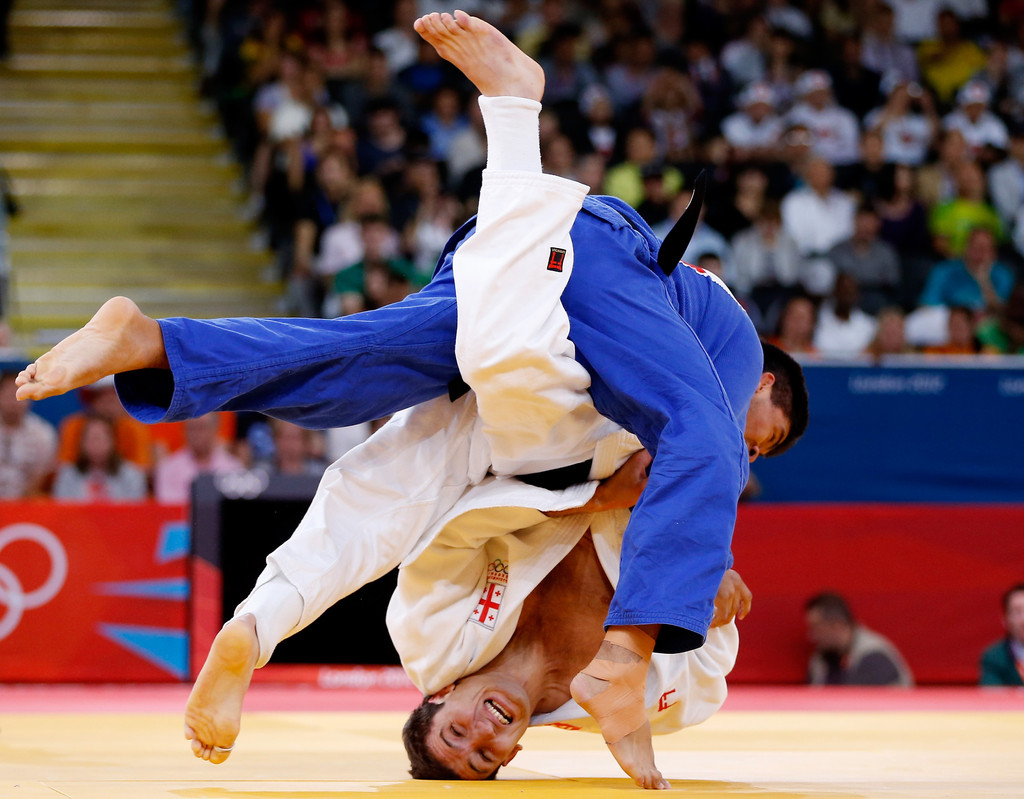
So the Judo competitions of this year’s (2016) Olympic Games in Rio de Janeiro, Brazil are all wrapped up. Well don’t worry, you can still watch the full-day event replays for a limited time on the CBC website (likely in Canada only, see your local broadcaster for listings/archives). Spoiler Alert:unfortunately Canada didn’t win any medals.
Both the qualifying rounds and repêchage/medal matches are available. In total there were 7 days of Judo action, running from August 6th to August 12th, 2016. Here are the links:
Don’t feel bad, I also had to lookup the term “repêchage”; turns out it is a French word which literally means “to finish up again”. Judo and other Olympic sports with tournament brackets (such as Wrestling, TKD, Cycling sprints and even Rowing) the repêchage round allows a fair chance for all (or some, depending on sport) of the losers to compete for the final medal(s) up for grabs. The two finalists of course get Gold and Silver, but any competitor who had already lost a match to one of the finalists and/or semi-finalists is guaranteed to get another chance for a medal (as long as they are injury-free and healthy enough to compete again). So don’t go drinking your woes away as soon as you hear the words “ippon” if you’re an Olympic Judoka who has lost, in case the person who defeated you goes on to the finals. In Judo, repêchage is fought for the Bronze medal. If you lose against a semi-finalist, you get to fight in the repêchage rounds in a mini-bracket for the Bronze. As such, the repêchage bracket is built from athletes who were knocked out by the finalists and building brackets to determine third place. The 1st & 2nd round losers fight each other, the winner of this fights the 3rd round loser, and so it goes until there are only two individuals remaining who fight for third place; the other competitors who made it to repêchage get a tie for 5th place. Repêchage addresses the possibility of two top competitors or favorites meeting in an early round where one is of course eliminated much earlier than their rank or skills would have indicated they should, thus it allows the early loser a chance to still compete for a Bronze medal. In part this is also to address the “Golden Score” rule that ensures that somebody wins and there are no draws or inconclusive bouts as each round is an elimination round. A major weakness of repêchage is to make sure that competitors are not paired with anyone from the same club, country, or social gathering to avoid conspiracies during the last match, such as: “if you let me have a yuko, and then you win by ippon, I’ll get the silver and not the bronze, but you win the gold all the same”. So it is important that contest individuals who may even remotely know each other must fight first in a repêchage system. The benefits of repêchage is that it is one of the best ways to work through a large number of competitors/teams, as it goes from a Qualifier or 100s down to Round of 64, Round of 32 then Round of 16, Quarterfinals, Semi-finals and finally the Gold medal match.
On to the Differences between Olympic Judo and Self-Defense Judo

 Musa Betsu Kyu Judo club