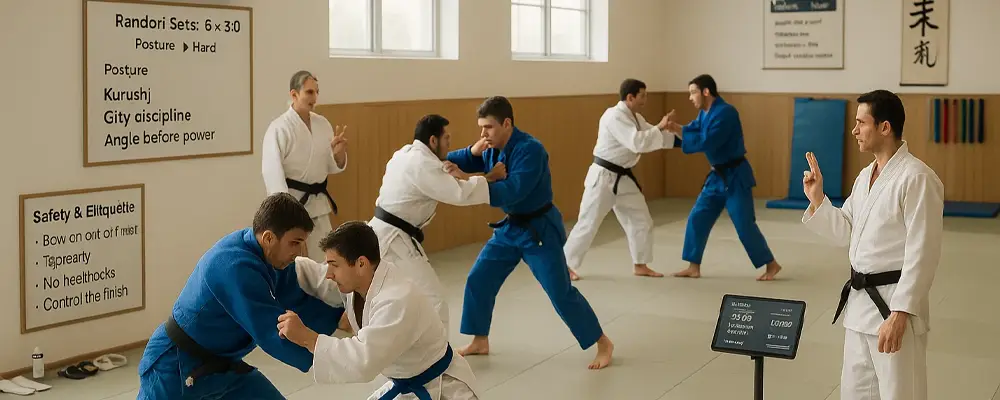
“Randori” (乱取り) literally translated as “free exercise” was conceived by Jigoro Kano for the Kodokan as a method of practicing hard while minimizing the risk of sustaining injuries. Kano defined the purpose of his randori method as “enticing interest in students through free-form technique application focused on safety, physical strength development and balance development”. To simplify the concept, it is basically sparring, where two competitors at a time are trying to implement legal Judo techniques with varying levels of resistance and exertion on either side, according to the rules of a regular competitive match. It is one of the most effective training mechanisms for preparing for each of the sport, martial art & self-defense sides of Judo.
There are many different ways to do randori though, and it should not always be two people going at one another fighting as hard as possible (in fact it should rarely be). Here are the top 25 most common, from lower to higher exertion & intensity levels:
Today, we’ll look at a few choking & strangulation techniques in the category of “originally from Judo” but now used – if not even sometimes “claimed as their own” by other martial arts – particularly BJJ (the “melting pot” of the grappling world). The term choke and strangulation are sometimes used inter-changably, but they are very different concepts and a proper understanding is essential before moving forward. There’s a reason that no one under orange belt is allowed to perform chokes or strangulations in Judo training or competition! Focus on the lower risk techniques first, then as you progress and expand your knowledge you can start to explore the rest the martial art has to offer.
It would be useful to clarify that a choke involves compression or other restriction of the throat, larynx, adam’s apple and/or “wind pipe” (trachea) to restrict oxygen intake and swallowing functions. Without oxygen, after anywhere from 20 to 120 seconds (sometimes a bit more in the extremely fit), depending on the persons involved, fainting and a risk of death by suffocation occurs. There is a higher likelihood of damage from these techniques as there is more time to struggle while force is resisted and applied.
Strangulation is the compression or other restriction of arteries (such as the carotid and/or vertebral) which restricts blood flow to the brain and/or spinal cord or other extremities. Without blood flow to the brain especially, a person risks unconsciousness within 4 to 20 seconds, and brain death or bodily death as it goes beyond that – especially approaching the minute mark or more – but often a fair bit less can also pose risks. Although less of a struggle ensues, due to proximity to all the same body parts there is still a possibility of all the same injuries in these techniques as well. A proper strangle greatly reduces the choking action, but there is likely still some, but this is the goal in most techniques referred to as a “choke”, to actually perform a more efficient and potentially less damaging “strangle” instead.
Some practitioners can simply hold their breath, go without a fresh supply of oxygen intake, or handle reduced/blocked blood flow far longer or shorter than others. So “sensible resistance .vs. force application levels” is not an exact science, which is why referees, instructors & practitioners all need to be trained for quick reactions and alertness when it comes to chokes and strangles. It does not always have to do with overall fitness levels as large muscles require more oxygen to feed the blood that pumps to them and more rapid blood circulation under duress, so its important to realize muscular folks sometimes can go a shorter duration without oxygen or full blood flow; however as expected the obese or unfit generally speaking do have a higher risk-level than active or athletic body types to such exposures.
Underlying health issues can further exacerbate an individual’s tolerances in either situation, so where sensible, these should be discussed with your instructor and/or training partners where this makes sense. Furthermore, it is generally considered higher risk for those over the age of 45 to face either situation (choking or particularly strangulation due to natural nearly unavoidable plaque & arterial buildup as we age) for any extended period of time or too frequently, so take this into account when training with older partners. Younger partners under the age of 18 whose central nervous system and heart haven’t completely developed yet are also susceptible to different kinds of injuries; particularly arterial dissection, trachial & laryngal fractures, fissures or tears, and spinal/neck injuries (although any of these and similar injuries could happen to anyone when techniques aren’t done or overseen properly).
Generally, if BJJ advises practitioners to go slowly and gradually increase pressure on a joint lock or choke in order to “give their opponent plenty of time to tap out” so we can continue to practice and learn together, then Judo airs even further on the side of caution and emphasizes that we should only apply such techniques “as briefly as possible for the teaching/learning and skill development goal to be realized“. At Judo class, its always better to proactively release an opponent than to “hold on a bit longer while they struggle to escape and decide if they want to tap”.
IMPORTANT: Neither choking nor strangulation should ever be performed or received in a careless manner and MUST in all cases be practiced with the supervision & oversight of a properly trained instructor, ideally with the appropriate first aid and/or medical first-responder certifications themselves, or with such services readily available nearby wherever such practice occurs.
Requisite disclaimer done, don’t be stupid… “don’t try this at home”… and GET PROPER TRAINING!
This post will summarize some of the better low-risk, high-reward throws that can be used in BJJ (gi) and similar grappling competitions.
The chosen “Top 15 successful throws for BJJ & grappling competitions” key criteria (similar to “the best throws for MMA” article so you’ll notice some overlap) are lower likelihood of getting your back taken (i.e. less focus on full-body turning throws), also in most grappling competitions except ADCC-style rules, big slams are probably not allowed, so they must be techniques that can be performed with a high degree of control. That also means you have a good chance to dictate where the match goes (do you go for a specific side-control, mount, north-south, scarfhold, etc).
This post is meant to clear up some confusion around gripping in Judo, and also to act as a reference for the grips most commonly seen in Judo. Let’s start with some other relevant terms that would be helpful to know:
Ai Yotsu – same grips used by both persons (traditional grip)
Eri – Collar (lapel) of gi
Gi – uniform typically with long-sleeves and sown lapels (collars)
Hansoku Make – disqualification from current match
Happo no Kuzushi – Unbalancing in 8 directions
Jigotai – defensive position
Kenka Yotsu – opposite grips used by each person, one right/one left
Kinshi Waza – techniques prohibited in athletic Judo competitions (typically based on IJF rules)
Kumi Kata – gripping strategy & fighting and/or hand-fighting
Hikite – pulling hand, usually the hand gripping a sleeve but could be gripping elsewhere
Shido – penalty in current match
Sode – sleeve of gi
Tachi Waza – standing technique
Tori – attacker, or, person performing a technique
Tsurite – lifting hand, usually the hand gripping a collar but could be gripping elsewhere
Uke – defender, or, opponent receiving a technique
Waki – arm pit region between arm/back/torso (underneath the shoulder joint)
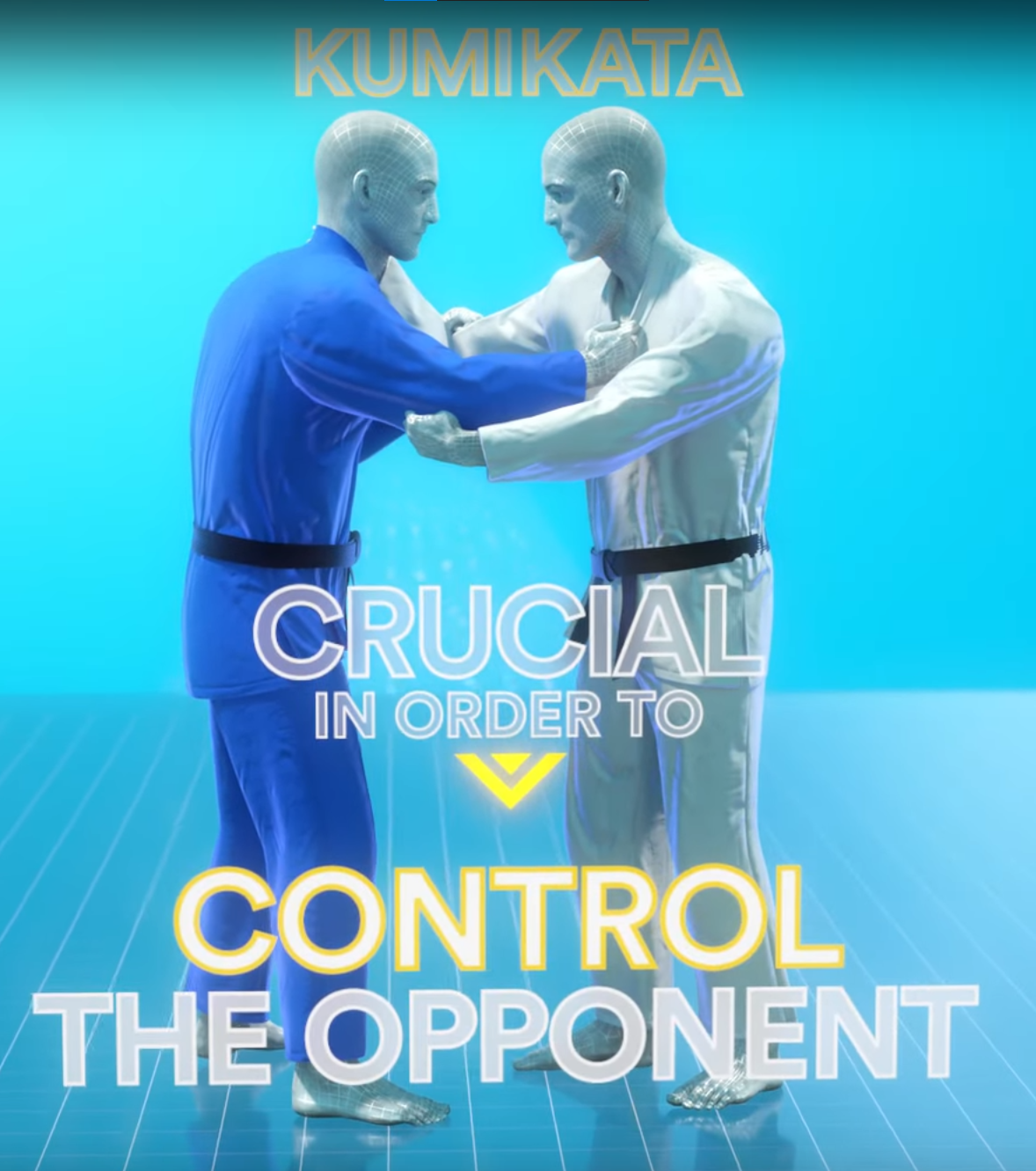
The importance of Kumi Kata (grip fighting) is often overlooked in Judo. It forms the basis of just about any attack. Not to mention, moving in aggressively without solid grips in place for control first should be considered reckless for the vast majority of Tachi Waza, and that itself can often even be penalized under failing to protect Uke. The following video does a great job at concisely summarizing Kumi Kata:
The remaining sections offer a description along with close-up photo example of all the main types of grips, grouped by “Standard” (traditional grips), “Modern” (accepted grips that require immediate throw attempts) or “Prohibited” (grips typically disallowed and/or frowned upon as unsportsmanlike in competition).
Standard Grips
Traditional grip (Ai Yotsu) – each have a high lead-hand lapel grip, and a mid-range rear-hand sleeve grip; note also the symmetric foot position (either left or right could be the lead, but the symmetry of the position is what makes it “Ai Yotsu“)
Traditional grip (Kenka Yotsu) – each have an opposite high lead-hand lapel grip, and opposite mid-range left-hand sleeve grip; note the asymmetric position of the feet (so per example below if the attacker has their left hand on top gripping the opponent’s lapel as lead Tsurite they also have their left leg forward, and right hand on their opponent’s sleeve as rear Hikite their right leg is back as supporting leg; or vice-versa)
The following is a list of the “Top 10 Judoka In MMA” using again like the previous post, no particular scientific formula, just going with general consensus. These are ranked not in order of their accomplishments but in the order in which they represent Judo exclusively, or made big shifts in consciousness towards awareness of Judo’s practical use in real fighting situations:
Ronda Rousey (Strikeforce / UFC)
Yoshihiro Akiyama (K1 / UFC)
Karo Parisyan (UFC / Bellator)
Hidehiko Yoshida (PRIDE / Sengoku)
Rick Hawn (Bellator)
Kazuhiro Nakamura (PRIDE / DREAM)
Hector Lombard (UFC)
Dong Hyun Kim (UFC)
Shinya Aoki (OneFC / RizinFF)
Fedor Emelianenko (PRIDE / Strikeforce / RizinFF)
WARNING: below there will be videos (non auto-playing) that depict scenes of violence that may be unsuitable for some audiences. These scenes are from legal, sanctioned, refereed combat sports events such as MMA, Judo, Combat Sambo, etc… and/or related supervised training activities.
Sure, as an experienced Judo practitioner it is completely easy to throw some random person out on the street who has no grappling experience (newsflash: you’d probably be able to do it within your first few Judo classes). It is also relatively easy to throw a Judo beginner or someone with an intermediate or lower level of other grappling Martial Arts, once they’ve finally decked themselves out in a starchy brand new Gi for the first few times and are just getting used to break-falling. However, it takes years to be able to pull-off a clean Judo throw against a resisting and experienced opponent, even if they’re wearing a Gi and competing under Judo rules. Against a fully-resisting, grappling-experienced, striking-empowered, aggressive, not to mention barely clothed and sweaty opponent? It’s damn near impossible. So remember that next time you are watching any combat sport like MMA or grappling events like Metamoris / ADCC and say “why doesn’t he just throw him on his head and win already” or “I thought he does Judo, so much for that being effective”.
The problem with many Judo techniques in the context of MMA is that if you commit completely to the technique (which you often have to for an effective throw) but the opponent somehow manages to resist then you are typically in a very bad situation where your back, neck and/or head are completely exposed; or, you are otherwise off-balance and can be countered or taken down hard & painfully yourself with low center-of-gravity wrestling techniques. With this level of risk, its no wonder only a select few are able to pull off Judo techniques with any amount of consistency or grace when competing at the highest levels. That said, it does happen. So long story short, what are the highest percentage techniques to attempt in the MMA ring/cage?
The Top 10 Judo throws most commonly pulled off in MMA include:
Osoto Gari
Sumi Gaeshi / Hikikomi Gaeshi
Kosoto Gake
Kata Guruma
Harai Goshi
Uchi Mata
Drop Seoi Nage variations
Ouchi Gari
Kouchi Gake
Harai Tsurikomi Ashi / Hiza Guruma
WARNING: below there will be “animated gif” (auto-playing on repeat) that depict scenes of violence that may be unsuitable for some audiences. These scenes are from legal, sanctioned, refereed combat sports events such as MMA, Judo, Kickboxing, etc… and/or related supervised training activities.
A typical discussion on the topic of Kata in Judo might go something like this:
Sensei: "People today don't appreciate Kata"
Student#1: "What the heck is a Kata?"
Sensei: "A routine of techniques and movements practiced as a tool for learning"
Student#1: "Ohh, that stuff, like punching in the air and yelling ki-ai, well that's nice but Judo doesn't have Kata right?"
Student#2:(looks to Student#1 next to him)... "Pssst, I think it's a joke/test, he's trying to see if we confuse Judo with Karate or something?!"
Sensei:(slaps forehead)... "You both still have a lot to learn, now drop and give me 20 pushups."
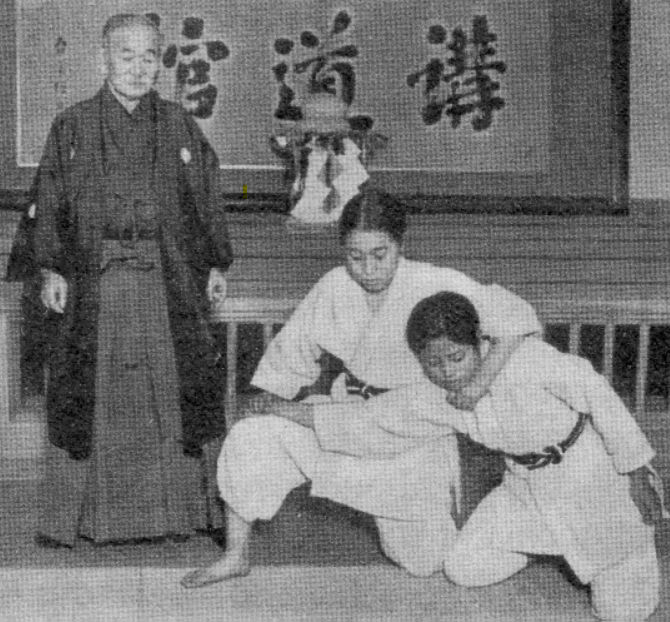
Jigoro Kano oversees students in performing Nage no Kata
The basic movements in a Kata can be used to assist in balance, strength & flexibility training in a manner relevant to most throwing techniques. Kata also assist in training spatial awareness, gripping, overall control, concentration, timing & that very important element of breathing.
Just ask some of the experts what the significance of Kata is:
“When properly performed, ju no kata gives a balanced exercise for the whole body. Constant use of this kata over an extended time period results in a harmoniously developed, flexible, and strong body, as well as giving the user the fundamental mechanics for sport and self defense Judo applications“
~ Donn F. Draeger (foremost western authority on Budo & translating martial arts texts/manuscripts)
“Kata is possibly the most misunderstood and sidestepped subject in nearly all judo circles”
~ Kenji Osugi
Kata can clearly be a very important part of any judoka’s training. The following is a set of links to the official Kodokan Kata texts (followed by video demonstrations).
Sankaku Jime (aka. “Triangle Choke”) applied during a Kosen Judo tournament, 1920
What is Kosen Judo?
Kosen Judo (高專柔道) is one of two main approaches to Judo training and competition (the other being Kodokan Judo) which are taught within Japan, the birthplace of that martial art and sport. Today, Kodokan Judo is by far the most dominant in terms of the number of clubs, instructors, students and competitions worldwide. While Kodokan Judo competition rules are recognized globally as the standard by the International Judo Federation (IJF) and are used for all Olympics and Worlds Judo competition, Kosen Judo is by contrast rarely heard of outside of Japan where it is still used during inter-University competitions (高專大会 kōsen taikai). Several organizations abroad such as the Freestyle Judo Alliance in North America, International Brazilian Jiu Jitsu Foundation (IBJJF) in South America and the European Sambo Federation, have adopted similar competition rules based on a combination of the more permissive ground fighting Kosen Judo rule set, blended to some degree with the stricter Olympic/Kodokan Judo rule set (some being even more permissive to allow striking, others adhering closer to Judo principles of using only throws and holds). Unlike Sambo or Brazilian Jiu Jitsu (BJJ) though, Kosen Judo is neither a different Martial Arts “style” nor is it simply a set of competition rules; rather, it is a spirit of preservation of Judo and Jiu-Jitsu traditions within the modernized sport-focused Judo community. Kosen Judo arose with this aim during the Meiji Era (1868–1914).
Development of Kosen and Kodokan Judo
Kodokan Judo was established primarily to turn dangerous yet effective techniques designed for the battlefield from traditional Jiu-Jitsu (which Samurai trained in for hand-to-hand fighting) and make them safer and more appealing to the general public (and thus, a broader array of potential students). Jiu-Jitsu was at the time, quite unfortunately, fading into obscurity as a relic of the old Samurai culture that was quickly being left behind by the Japanese public who seemed to be in favour of industrialization and modernization (not to mention the fact that it was being rendered much less important for the government due to ballistic advancements in military technology). Kodokan founder, the honorable Jigoro Kano, knew from his early studies in human anatomy, physiology/kinetics and anthropology that people are competitive by nature; yet he also observed when learning under Osteopath and Jiu-Jitsu master Hachinosuke Fukuda that people do not like to get hurt and injuries in a sport/activity often lead to abandonment of that sport/activity or outright inactivity. This lead him to develop a set of rules for safe competition, as well as a new school called the Kodokan Institute in 1882.
Military Rifles and Jiu-Jitsu practice at an “Agricultural School” in early 1900s Japan
The departure from the traditional schools of thought on “fights to the death” and “survival (i.e. participation) of the fittest” which were so prevalent before the founding of the Kodokan, represents some key improvements Kano introduced. Like all new schools of thought though, there was initially stern condemnation of Kano’s approach and constant challenges from traditional Jiu-Jitsu masters within Japan. Despite this adversity, Kano’s own abilities, passion for teaching and unwavering dedication to his vision saw Judo rise in prominence across the country at the turn of the 20th century. It was becoming apparent that the only way many traditional Jiu-Jitsu techniques may survive would be to find a way to get included in the new “Kodokan curriculum” and “sport of Judo” being developed by Kano. As a result, followers of the old ways of Jiu-Jitsu had three choices: quit altogether, join him, or ignore him. A vast majority of those who chose to “ignore him” could at least agree that he had a brilliant idea to make Martial studies more appealing to the masses, and attempted to develop their own streams of sport Jiu-Jitsu (their own “Judo”, in essence).



 Musa Betsu Kyu Judo club