A typical discussion on the topic of Kata in Judo might go something like this:
Sensei: "People today don't appreciate Kata"
Student#1: "What the heck is a Kata?"
Sensei: "A routine of techniques and movements practiced as a tool for learning"
Student#1:  "Ohh, that stuff, like punching in the air and yelling ki-ai, well that's nice but Judo doesn't have Kata right?"
Student#2: (looks to Student#1 next to him)... "Pssst, I think it's a joke/test, he's trying to see if we confuse Judo with Karate or something?!"
Sensei: (slaps forehead)... "You both still have a lot to learn, now drop and give me 20 pushups."
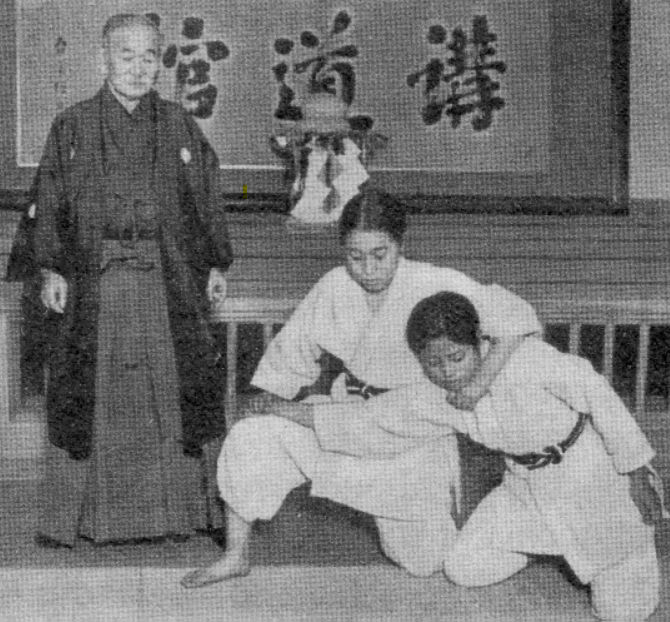
The basic movements in a Kata can be used to assist in balance, strength & flexibility training in a manner relevant to most throwing techniques. Kata also assist in training spatial awareness, gripping, overall control, concentration, timing & that very important element of breathing.
Just ask some of the experts what the significance of Kata is:
“When properly performed, ju no kata gives a balanced exercise for the whole body. Constant use of this kata over an extended time period results in a harmoniously developed, flexible, and strong body, as well as giving the user the fundamental mechanics for sport and self defense Judo applications“
~ Donn F. Draeger (foremost western authority on Budo & translating martial arts texts/manuscripts)
“Kata is possibly the most misunderstood and sidestepped subject in nearly all judo circles”
~ Kenji Osugi
Kata can clearly be a very important part of any judoka’s training. The following is a set of links to the official Kodokan Kata texts (followed by video demonstrations).
- Nage no Kata – forms of throwing
Technique Summary (in order)
- Te Waza (hand techniques)
- Koshi Waza (hip throws)
- Ashi Waza (leg techniques)
- Ma Sutemi Waza (front-facing sacrifice throws)
- Yoko Sutemi Waza (side-facing sacrifice throws)
- Katame no Kata – forms of grappling & pinning
Technique Summary (in order)
- Osaekomi Waza (pinning/hold-down techniques)
- Shime Waza (choking/strangulation techniques)
- Kansetsu Waza (joint-locking techniques)
- Kime no Kata – forms of “real fighting” for preventive attacks by an aggressor (with and without weapons)
Technique Summary (in order)
- Idori (kneeling empty hand defense)
- Ryote dori (double wrist grab) –> kick –> Ude hishigi waki gatame
- Tsukakke (straight punch) –> dodge/punch –> Ude hishigi hara gatame
- Suri age (slap/palm strike) –> block/kick –> Ude hishigi te gatame
- Yoko uchi (hammer/downward strike) –> dodge –> Sumi otoshi (back grip) –> elbow
- Ushiro dori (rear grab) –> Seoi otoshi (rolling variation) –> punch
- Tanto Idori (kneeling dagger/knife defense)
- Tsukkomi (thrust/stab with fake knife) –> punch –> Ude hishigi hara gatame
- Kirikomi (downward slash with fake knife) –> block –> Ude hishigi waki gatame
- Yoko tsuki (side stab with fake knife) –> deflect/punch –> Ude hishigi hara gatame
- Tsukkomi (thrust/stab with fake knife) –> dodge/punch –> Ude hishigi hara gatame
- Tachiai (standing empty hand defense)
- Ryote dori (double wrist grab) –> kick –> Ude hishigi waki gatame
- Sode dori (sleeve grab & push) –> side kick –> Harai goshi
- Tsukakke (straight punch) –> block/dodge –> Hadaka jime
- Tsuki age (uppercut punch) –> block/dodge –> Ude hishigi waki gatame
- Suri age (slap/palm strike) –> block/punch –> Uki goshi
- Yoko uchi (hammer/downward strike) –> dodge –> Okuri eri jime
- Ke age (front/snap kick) –> block/grab/kick –> Kibisu gaeshi (position only, no throw)
- Ushiro dori (rear grab) –> Seoi nage (rolling variation) –> chop
- Tanto Tachiai (standing dagger/knife defense)
- Tsukkomi (thrust/stab with fake knife) –> dodge/punch –> Ude hishigi hara gatame
- Kirikomi (downward slash with fake knife) –> block/parry –> Ude hishigi waki gatame
- Katana Tachiai (standing sword defense)
- Nuki gake (sword draw) –> prevent/grab –> Kata ha jime
- Kiri oroshi (downward slash with sword) –> block/grab –> Ude hishigi hara gatame
- Ju no Kata – forms of gentleness
- Goshin Jutsu no Kata – forms for self-defense against attack & weapons
- Itsutsu no Kata – “forms of five” (concepts) of energy, deflection, circularity, action/reaction, void
- Koshiki no Kata – throws listed, but not fully published yet
- Seiryoku Zenyo Kokumin Taiiku no Kata –


December 2, 2016 at 9:47 am
Kano considered judo training to be an aid to the student’s educational aspirations. His ultimate ambition was to produce students of fine character, so that they would in future become useful, educated citizens and thus benefit society.
THE ETHOS OF JUDO
‘The purpose of judo is to perfect oneself physically, intellectually and morally for the benefit of society.’
Professor Jigoro Kano (1860-1938)
(The Father of Judo, Kodansha International, 2000)
(IL Padre Del Judo, Edizioni Mediterranee, 2005)
(Judo Memoirs of Jigoro Kano, Trafford Publishing, 2008, 2014)
(Memorias de Jigoro Kano, Editora Cultrix, 2011)
JIGORO KANO’S
VISIT TO
SEATTLE DOJO
by
Brian N. Watson
Before the great expansion in air travel that started in the 1950s, most passengers journeyed overseas on ocean liners. One of the ships that often sailed the Japan – U.S.A. routes was NYK Line’s workhorse the Hikawamaru. This cargo-passenger liner reportedly made the two-week trip between Yokohama and the then gateway to the US, Seattle, 254 times between 1930 and 1960 when she was finally decommissioned and became a floating restaurant and later refurbished (2006-2008) and reopened as an Important Cultural Property permanently moored at the port of Yokohama. Professor Jigoro Kano, who made some 13 extended overseas trips in his lifetime, on occasions voyaged on the Hikawamaru, as did many other celebrities of the day.
The Seattle Judo Club, established in 1902, was reportedly the very first judo dojo to open on US soil. Jigoro Kano (1860-1938) seated in the centre of this photograph, called at this dojo twice, once in 1936 and again in 1938.
After attending the International Olympic Committee meeting held in Cairo, Egypt, in 1937, he later visited several European cities, then New York, Seattle and finally Canada. On April 23, 1938 Kano headed home and left Vancouver Harbor on the Hikawamaru, which was scheduled to arrive at Yokohama on May 6. However, he did not live to see his homeland again. En route, at the age of 77; he succumbed to pneumonia and died on this vessel on May 4, 1938.
Brian N. Watson
Tokyo
30 October 2016
References: (The Father of Judo, Kodansha International, 2000)
(Judo Memoirs of Jigoro Kano, Trafford Publishing, 2008)
Seattle Judo Club photograph courtesy of Ken Morinaka
LikeLike